The flagship service
A custom abstract service for the county you care about. We build out every GLO survey abstract in the county, in the priority you set, and deliver each as a linked nine-sheet workbook your landman team uses to construct the MOR. Typically a subscription with runsheets refreshed nightly. Your existing title work folds in as a private input.
What you get
Foundation ships abstract by abstract. Each abstract you scope arrives as a nine-sheet workbook on the same spine. Click any 🔗 in the workbook to open the corresponding source document in the viewer, full document image alongside the OCR text.
| # | Sheet | What's in it |
|---|---|---|
| 1 | Overview | Section title, narrative summary, table of contents |
| 2 | Runsheet | Every recorded instrument touching the tract, chronological and normalized, with Abstractor's Notes on every row |
| 3 | Surface Tracts | Surface owners of record with acreage, situs, land use, market value |
| 4 | Mineral Tracts | Severed mineral estates, each linked to the deed that created the severance |
| 5 | Mineral Ownership | Resolved current owners: fee mineral / NPRI / ORRI / leasehold |
| 6 | Wells & Permits | Railroad Commission data joined to the tract; HBP status with reasoning |
| 7 | Skip Trace | Name, phone, address, age, relatives for every identified owner |
| 8 | Tract Notes | Senior abstractor's plain-English memo: chain health, lease status, recommended actions |
| 9 | Document Library | Every source PDF with deliberate filename nomenclature; downloadable as a single ZIP |
How it's tailored
You tell us which abstracts matter, an acquisition AOI, a leasing campaign, an HBP defense file, and we work them in that order. We don't try to dump a county-sized workbook on your desk; we build the abstracts you actually need, one workbook at a time, on the cadence you set.
If your team or counsel already has title for parts of the county, ship it to us and we treat it as a private input. Our records cross-check yours, flag conflicts, and fill the gaps, so your engagement compounds the work you've already paid for instead of redoing it.
Most engagements run as a subscription. Each night we re-pull the clerk's index, RRC filings, and CAD changes, then update every abstract workbook in your scope. The runsheets you opened yesterday morning are current by the time you sit down today.
Before any of that, our process starts with cursory runsheets across the entire county, so the spine is in place before we drill into the abstracts you care about. That up-front pass is on us, it's how we set the standing index every Foundation engagement runs on.
Two pieces of the work
Clerk indices come in messy. The same person often shows up under several spellings. Instrument types are written as "WD," "Warranty Deed," and "WARR DEED" on the same county roll. Legal descriptions are free-text. Operator names don't always match RRC P-5.
We work through the index and bring each name, operator, instrument type, and legal description to one consistent version across the county. Every reconciliation is recorded, so we can show our work if you ever want to see it.
The Railroad Commission publishes well, permit, lease, and production data across several different files. Most teams pull them separately. We stitch them together and join the result back to the GLO survey abstract underneath.
The per-abstract row tells you well count, operator, status, spud date, first production, last production month, current production tier, lease ID, and a plain-English read on whether the acreage is being held by production.
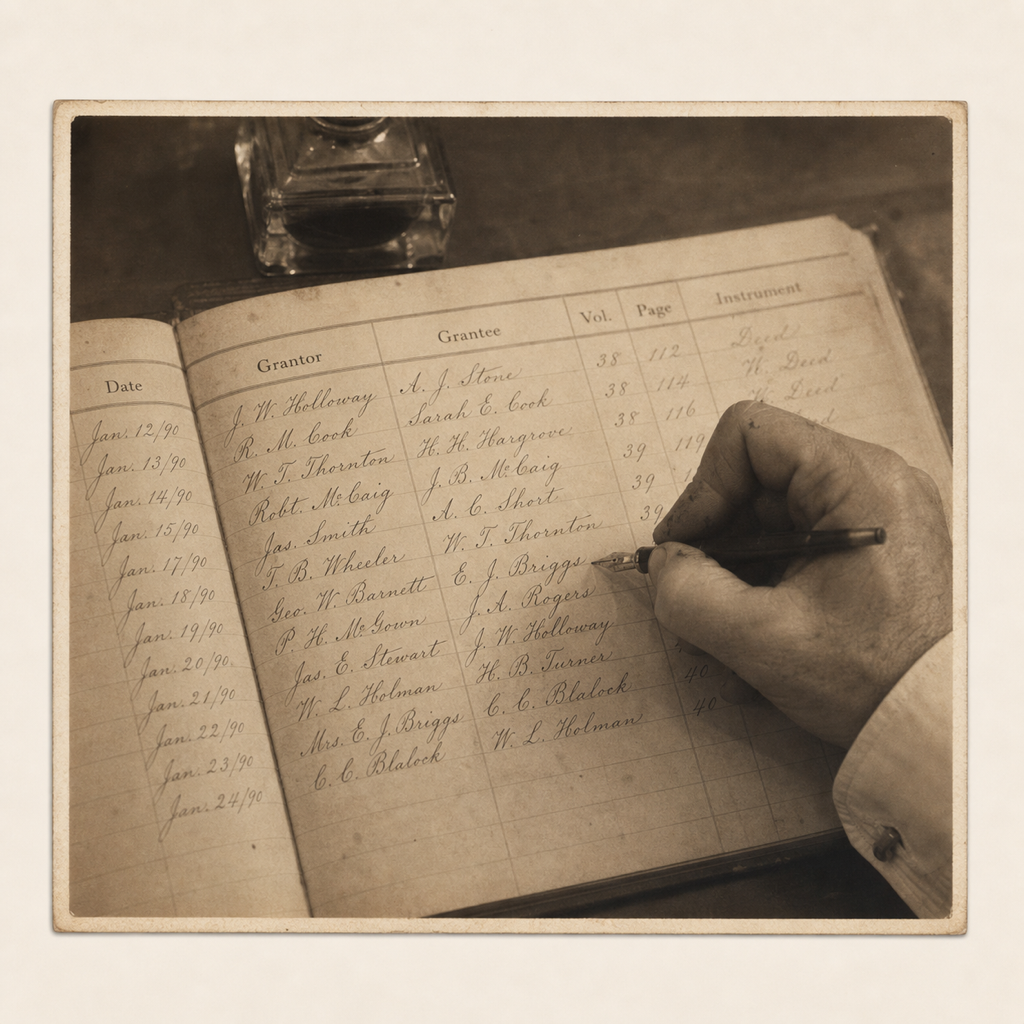
Three ways to engage
A targeted set of abstracts in your county, scoped to a defined AOI or campaign.
An expanded scope with a senior abstractor on the file. Your existing title work folds in as a private input.
An ongoing subscription. Nightly runsheet refresh, expanding abstract coverage on your priority order, and day-rate landmen on call for whatever the county actually needs.
See pricing tiers, scoped per county and per use case. Request a quote
Turnaround
The counties we source are pre-vetted before you ever ask. When you scope an abstract, our standing index is already in shape. Your five-day clock is the abstractor working that specific abstract on top of records that are already normalized and chained. On a subscription, abstracts after the first ship faster, and existing workbooks refresh nightly. How it works →
Custom jobs that need specialty language work (litigation-grade chain construction, expert-witness research, curative drafting) are scoped and quoted separately on a day-rate basis. Or narrow the scope to a single tract with a tract runsheet. Custom Abstracting →